Beneath the Headlines: Three Crises India Cannot Afford to Look Away From
Verified Editorial
Source: BharathPulse Exclusive
⚡ Key Takeaways
- Student Suicides, Disability Rights, Deepfakes — A Magazine Report.
SOCIETY | SPECIAL REPORT
Beneath the Headlines
Three Crises India Cannot Afford to Look Away From
Student Suicides · Disability Rights · Deepfakes — A Magazine Report | June 2026
सुर्खियों के पीछे | Bilingual Edition: English & Hindi
─── ENGLISH ───
Introduction: The Stories Nobody Is Telling Enough
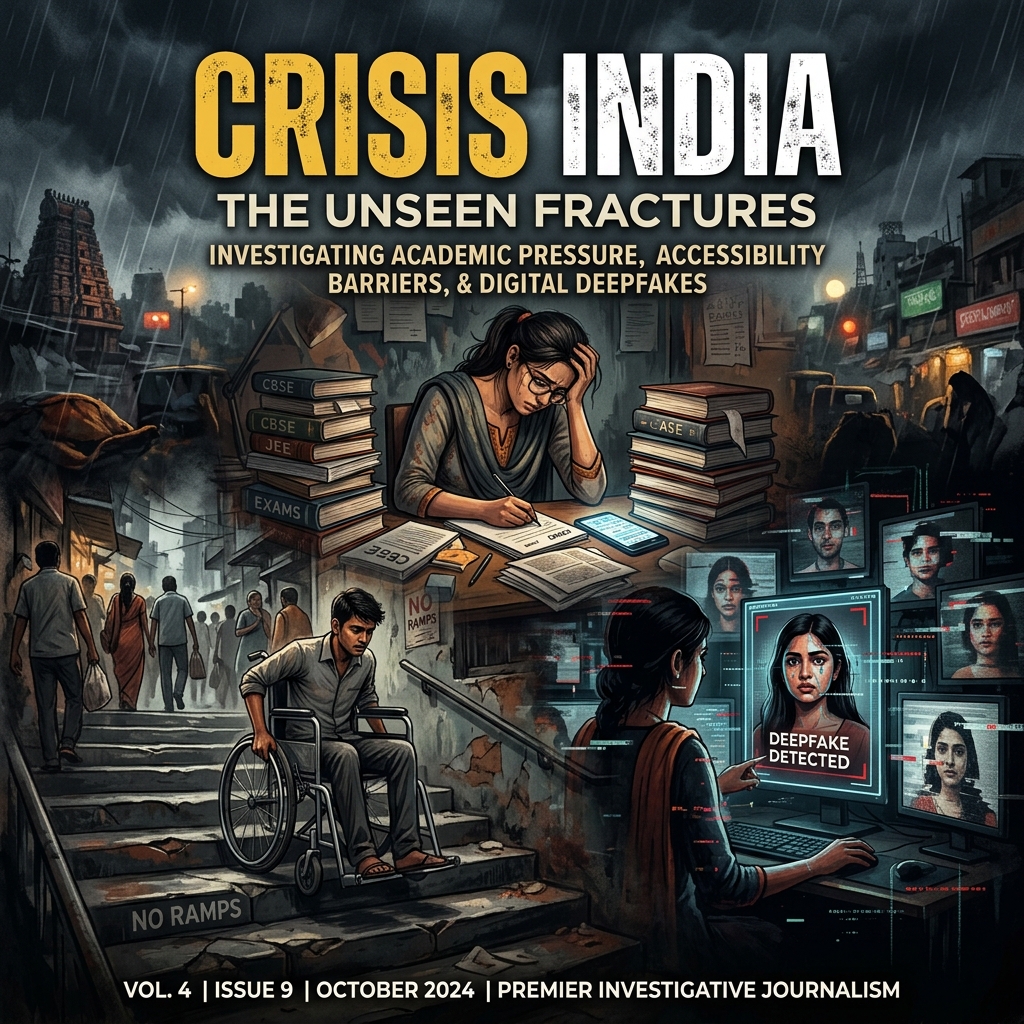
India's front pages overflow with politics, cricket and celebrity. But quietly, almost inaudibly, three urgent crises are reshaping the daily lives of millions. Students are dying at rates that should shock a nation into action. Twenty-seven million citizens with disabilities are being held back by laws that exist on paper but rarely in practice. And women across every state are waking up to find their faces weaponised in deepfake pornography, with almost no legal recourse.
This report goes beneath the headlines — into the numbers, the court battles, the survivors' testimonies, and the policy vacuums — to tell the stories that deserve far more attention than they receive.
"Failure in examination" — the three words used to describe 2,032 deaths in a single year.
STORY ONE: The Dying Students
A Nation That Turns Its Children Into Statistics
Every 36 minutes, somewhere in India, a student takes their own life. That is the arithmetic of the 2024 National Crime Records Bureau data, which records 14,488 student deaths by suicide — the highest figure in a decade, and a 73% rise from 8,032 in 2014. While the national suicide rate actually edged slightly downward in 2024, student suicides bucked that trend decisively, rising by 4.3% from the previous year, faster than the broader population. Students now account for 8.5% of all suicides in India.
These are not abstractions. They are 14,488 individual human beings — teenagers in Kota dormitories, school-leavers in UP, undergraduates in Maharashtra — whose ambitions, anxieties, and endings are compressed into a government spreadsheet each year.
Source: NCRB Accidental Deaths and Suicides in India reports, 2014–2024
The Pressure Cooker: How India's Education System Fails Its Students
The causes, according to a decade of NCRB data, are heartbreakingly familiar. "Failure in examination" directly contributed to 2,032 deaths in 2024 across all age groups. Among children below 18, exam failure was the leading recorded cause in 1,071 cases, while family problems contributed to 3,101. The most vulnerable age window is 16 to 21 years — the years when young people must face high-stakes entrance examinations like JEE and NEET, whose outcomes are widely treated as life-defining verdicts.
"Every 36 minutes, a student in India dies by suicide. And still, the country debates exam schedules rather than mental health support."
Kota, Rajasthan — India's coaching capital, where hundreds of thousands of young people converge each year to prepare for engineering and medical entrance exams — has become a symbol of this crisis. The city reported 17 deaths specifically attributed to exam failure and 95 more attributed to family problems among students in 2023-24 data. Calls to the local helplines spike predictably around exam season. The Union Education Ministry has issued guidelines to coaching institutes, but enforcement is patchy and the culture of 12-hour daily study schedules remains largely intact.
14,488 — students died by suicide in India in 2024 — one every 36 minutes
73% — rise in student suicides from 2014 to 2024 (8,032 → 14,488)
Who Is Most at Risk?
The NCRB data cuts across every level of education. The largest share — 25.6% — comes from students educated up to Grade 10 (secondary level), followed by Grade 12 students (18.3%), middle-school students in Grade 8 (17.7%), and even primary school pupils in Grade 5 (14.4%). Children as young as 9 are appearing in the data. The crisis is not confined to the rarefied world of IIT aspirants; it runs through the entire education system.
Geographically, Maharashtra leads with 14.7% of all student suicide deaths (2,046 cases in 2023), followed by Madhya Pradesh (10.5%), Uttar Pradesh (9.9%), and Tamil Nadu (9.6%). These are among India's largest and most populous states, but the concentration also reflects systemic pressures that are particularly acute in these regions.
The Response Gap: Policy vs. Practice
Mental health counsellors remain scarce in Indian schools and colleges. A 2024 University of Birmingham study confirmed that the 16-21 age group is the most vulnerable demographic — yet this is precisely the cohort least likely to have access to in-school psychological support. The National Education Policy 2020 acknowledged mental health as a priority; the National Curriculum Framework that followed recommended school counsellors. But implementation is left to states, and coverage is wildly uneven.
A July 2025 Deutsche Welle report described academic pressure as the leading cause of student suicides, alongside bullying, ragging, family conflicts, depression, and anxiety — a multi-causal crisis that demands a multi-level response. What India has instead is a patchwork of helplines, sporadic guideline circulars, and a school system where a student's worth continues to be measured almost entirely by a mark sheet.
"We do not have a student suicide crisis. We have a dignity crisis — a system that tells children they are only as good as their rank."
India has 27 million people with disabilities. Their rights exist in law. In practice, a different reality persists.
STORY TWO: The Invisible Wall
India's 27 Million People with Disabilities and the Law That Hasn't Reached Them
India has approximately 27 million citizens with disabilities — a population comparable in size to Australia. It has laws designed to protect them: the Rights of Persons with Disabilities (RPWD) Act 2016 was landmark legislation that replaced the outdated 1995 Act, expanded the definition of disability to 21 categories, aligned Indian law with the United Nations Convention on the Rights of Persons with Disabilities (CRPD), and embedded obligations on both public and private sectors to ensure non-discrimination, reasonable accommodation, and universal accessibility.
On paper, it is progressive. On the ground, the gap between the statute and lived reality remains, in the words of a January 2026 peer-reviewed study, an "enforcement gap" — wide, deep, and largely invisible to a media and political class that rarely centres disabled voices.
The Supreme Court Finally Speaks: The Rajive Raturi Judgment (2024)
For years, the RPWD Act's accessibility mandate was undermined by a subtle but critical flaw: the language of Rule 15 — which governed accessibility guidelines — contained no compulsion to comply. The Union of India repeatedly insisted the rules were mandatory while the text said otherwise. In November 2024, the Supreme Court of India, in the landmark case Rajive Raturi v. Union of India, called out this contradiction directly.
The bench declared Rule 15 ultra vires — beyond the powers permitted by — the RPWD Act itself, and directed the government to frame genuinely mandatory accessibility rules under Section 40 within three months. Chief Justice D.Y. Chandrachud's bench emphasised that "accessibility is not just a right but a shared responsibility" and that uniform, mandatory standards were needed across both public and private sectors.
"The government kept telling courts the rules were mandatory. The Court looked at the text and said: they are not. That is the story of disability rights in India in one exchange."
27 million — citizens with disabilities in India — a population the size of Australia
21 categories — of disability now recognised under the RPWD Act 2016
The Digital Exclusion
In August 2024, the Chief Commissioner for Persons with Disabilities issued notices to over 140 private and public entities for failing to meet digital accessibility standards under the RPWD Act. The banking sector was given specific directives in February 2024 to make digital platforms accessible. The Reserve Bank of India followed in October 2024 with mandatory accessibility guidelines for digital banking services. Penalties — Rs 10,000 per violation — were imposed on 155 establishments, including government ministries.
It is a telling list. Government ministries among the worst violators of the very laws they are responsible for enforcing. The pattern reflects a broader cultural reality: disability continues to be viewed through a lens of charity and medical deficiency rather than through the rights-based framework the RPWD Act was designed to embed. Even India's digital transformation — the UPI revolution, the Aadhaar ecosystem, the push to online government services — has largely been designed without the needs of blind, hearing-impaired, or motor-disabled users in mind.
Education and Employment: Doors Still Closed
In September 2025, the Central Administrative Tribunal ruled in favour of candidates with Specific Learning Disability (dyslexia) who had been excluded from reservation benefits in the UPSC Civil Services Examination — despite dyslexia being explicitly recognised under the RPWD Act. That any examination authority could exclude a category of disability that Parliament had legislated to protect illustrates how far the culture of implementation lags behind the culture of legislation.
The education sector mirrors this gap. Schools remain physically inaccessible; curricula are not designed for neurodivergent learners; teacher training in disability inclusion is minimal. Activists have argued for years that the RPwD Act's "inclusive education" mandate requires not just ramps and braille books, but a wholesale rethinking of pedagogy — a rethinking that is not happening at scale.
"We passed a world-class disability law in 2016. Ten years later, government ministries are still being fined for inaccessible websites."
96–98% of deepfake videos online are sexually explicit. Nearly all victims are women.
STORY THREE: Faces Stolen, Lives Shattered
India's Deepfake Crisis and the Law That Doesn't Exist Yet
In June 2024, a 14-year-old girl in Uttar Pradesh found that someone had created an obscene deepfake video using her face. Police filed a case. The video continued to circulate. She was the victim of a technology that barely existed a decade ago and that Indian law has still not specifically criminalized.
This is not an isolated story. It is a pattern. Bollywood and Tollywood actresses, female journalists, social media influencers, college students, and private citizens have all been targeted. A technology that manipulates artificial intelligence to swap faces in videos — creating convincing fake footage in which someone appears to do or say things they never did — has been weaponised primarily against women, primarily as a sexual tool, at a scale that is accelerating faster than regulators are responding.
Sources: Sumsub 2024; VIF India 2025; National Cybercrime Reporting Portal; Security Hero 2023 State of Deepfakes
The Numbers Are Staggering
According to the 2023 State of Deepfakes report, there were 95,820 deepfake videos online that year — a 550% increase over 2019. Between 2022 and 2023 alone, the volume of deepfakes increased by 3,000%. Sumsub, a global identity verification company, reported a 280% year-on-year rise in deepfake incidents in Q1 2024, particularly around India's general elections. By 2024, deepfakes accounted for 40% of all biometric fraud globally, with deepfake attempts occurring at a rate of one every five minutes.
The gendered dimension is stark. Between 96% and 98% of deepfake videos online are sexually explicit. Nearly all victims are women. India's National Cybercrime Reporting Portal has recorded a 118.4% rise in online crimes against women — from 22,188 cases in 2020 to 48,475 in 2024. The category includes deepfakes, non-consensual intimate imagery, and sexual content created without consent.
550% — rise in deepfake videos from 2019 to 2023 (now 95,820+ online)
118.4% — rise in online crimes against women in India (2020–2024)
India's Legal Framework: Patchy, Insufficient, and Often Silent
Here is the crux of the problem: India has no dedicated deepfake law. The government, responding to a parliamentary question in August 2025, asserted that existing legislation — the Information Technology Act 2000, the Bharatiya Nyaya Sanhita 2023, the POCSO Act, and the IT Rules 2021 — are collectively sufficient to address deepfake crimes. Critics say they are not.
Charges in deepfake cases are typically filed under Sections 66C (identity theft), 66E (privacy violation), and 67/67A (obscene content) of the IT Act, alongside relevant provisions of the Bharatiya Nyaya Sanhita. But these provisions were never designed for AI-generated synthetic media. They do not address the specific nature of deepfakes — the non-consensual use of a person's likeness, the question of AI tool liability, the speed of dissemination, or the near-impossibility of complete content removal once a video goes viral.
"India's legal architecture offers almost no direct recourse for deepfake victims. What exists was written before the technology existed."
The IT Rules 2021: A Partial Shield
The most useful existing provision is the IT Rules 2021 obligation on social media intermediaries — platforms like Meta, Google, and X — to take down non-consensual images within 24 hours of a complaint. Advisories issued in December 2023 and March 2024 reminded intermediaries of this obligation and directed them to label AI-generated content. CERT-In (India's computer emergency response team) issued an advisory on deepfake threats in November 2024.
In practice, enforcement is inconsistent. Cross-border deepfake crimes present particular challenges: a video generated by a tool hosted in one country, uploaded via a server in another, targeting a woman in a third, is practically beyond the reach of any single jurisdiction. Cases that are registered often go nowhere because forensic capacity and digital expertise within state police forces vary enormously.
What Needs to Change
Experts and advocacy groups have outlined a three-pronged response. First, a dedicated deepfake-specific statute that criminalises the non-consensual creation and distribution of synthetic sexual media, mandates content watermarking and metadata traceability, and sets liability standards for AI tool providers. Second, a bilateral treaty framework for cross-border AI cybercrime, modelled on existing mutual legal assistance treaties but updated for AI-era realities. Third, a national digital literacy mission that reaches young people — particularly girls — before they become victims.
India's 2025 regulatory framework — the BNS, the Digital Personal Data Protection Act, the updated IT Rules — represents a shift from passive observation to active engagement with digital harms. But the forensic muscle, the investigative capacity, and the victim support infrastructure are still catching up. For the 14-year-old girl in UP whose face was stolen, the law moved too slowly.
What These Three Crises Have in Common
A student in Kota who cannot speak to anyone about the terror of failing her entrance exam. A wheelchair user in Delhi who cannot enter a government ministry because there is no ramp. A woman in Chennai who cannot get a deepfake video of herself removed before thousands have seen it. Three people. Three different crises. One shared condition: a system that has not caught up with their reality.
In each case, the law is ahead of the enforcement. India has policies for mental health in education. It has the RPWD Act. It has cybercrime provisions. What it lacks is the consistent, resourced, accountable implementation that turns good law into lived dignity. The numbers, the court judgments, and the survivor testimonies in this report are not arguments for despair — they are arguments for urgency.
Every 36 minutes, a student dies. Every day, a disabled citizen is turned away from a space they have the legal right to enter. Every five minutes, somewhere in the world, a deepfake attempt is made. The headlines may be elsewhere. But these are the stories that will define what kind of society India is becoming.